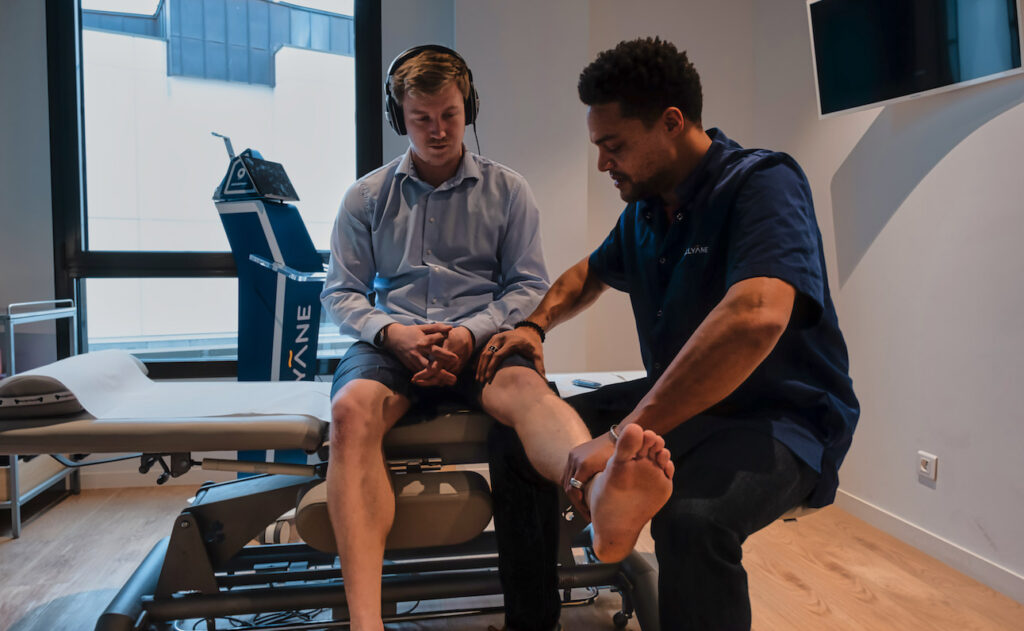
Following a knee sprain, following a tailored rehabilitation program guided by healthcare professionals is essential for the patient to regain optimal mobility. In addition to physical therapy sessions and, if necessary, motor re-education, certain exercises can be performed at home to speed up the patient’s recovery. Here is a selection of targeted exercises for knee rehabilitation.
1. Knee Flexion and Extension Exercise
To perform a bend:
- Sit in a chair with your foot flat on the floor, and slowly slide your foot backward to bend your knee, without exceeding your pain threshold.
- Hold the position for 3 seconds, then return to the starting position.
To perform an extension:
- From the same position, straighten your leg by lifting your foot in front of you until you feel a slight stretch, without crossing the pain threshold.
- Hold the position for 3 seconds before releasing.
When and how often should you do this exercise?
Once you have received the go-ahead from your physical therapist, do 20 repetitions, 3 to 5 times a day.
2. Goodmorning with an elastic band
This exercise helps strengthen the hamstrings and improve knee stability.
- Place an elastic band around your shoulders and under your feet.
- Lean forward, keeping your back straight and your knees slightly bent.
- Slowly come back up by contracting your hamstrings and glutes.
When and how often should you do this exercise?
Do 3 sets of 10 to 12 repetitions, 2 to 3 times a week.
3. Circular leg movements exercise
While lying on your back or sitting, make circular movements with your leg to gently mobilize your knee:
- Draw circles with your leg in both directions (clockwise and counterclockwise).
- Be sure to stay within a comfortable range.
When and how often should you do this exercise?
Do about 20 repetitions a day once the pain subsides.
4. The single-leg deadlift
This exercise helps improve proprioception and strengthen the muscles that stabilize the joint.
- Standing on one leg, hold a light weight in your opposite hand.
- Lean your upper body forward while lifting your other leg backward until your back forms a straight line.
- Slowly return to the starting position.
When and how often should you do this exercise?
Do 2 sets of 8 repetitions per leg, 3 times a week.
5. The Glute Bridge
The glute bridge is an exercise that helps strengthen the glutes and support the knees by stabilizing the pelvis.
- Lie on your back with your knees bent and your feet flat on the floor.
- Lift your hips by contracting your glutes until your knees and shoulders form a straight line.
- Hold the position for 3 seconds before slowly lowering yourself back down.
When and how often should you do this exercise?
Do 3 sets of 15 repetitions, 3 times a week.
6. Step-through Exercise
Standing up, do this exercise to restore proper knee movement while walking and help your knee get used to bearing weight again:
- Start in a standing position, with your weight on your healthy leg.
- Gradually shift your weight onto your injured leg by taking a small step forward.
- Gently roll your foot from heel to toe, and bend your knee slightly if necessary.
When and how often should you do this exercise?
Perform 10 movements as directed by your therapist.
7. Leg Curl with a Resistance Band
This exercise targets the hamstrings to strengthen knee flexion.
- Wrap an elastic band around your ankle and attach the other end to a sturdy support.
- While standing, bend your knee to pull the resistance band backward, maintaining controlled tension.
- Slowly return to the starting position.
When and how often should you do this exercise?
Do 3 sets of 12 repetitions per leg, 2 to 3 times a week.
Why do rehabilitation exercises after a knee sprain?
Rehabilitation following a knee sprain is an essential step in helping the patient regain optimal joint function and prevent potential long-term complications (such asknee hyperextension, etc.).
After a sprain, it is common for the knee to lose flexibility and range of motion, particularly due to pain, inflammation, and ligament damage. Rehabilitation helps gently stretch the muscles and ligaments, thereby promoting a gradual return to mobility. Flexion and extension exercises, for example, play a key role in restoring this mobility, which is essential for walking, running, and other daily activities.
The muscles surrounding the knee—including the quadriceps, hamstrings, and calves—are important stabilizers of the joint. After a knee sprain, these muscles may weaken due to immobilization or reduced activity. Rehabilitation includes targeted muscle-strengthening exercises to restore muscle strength and ensure better knee stability. Ligaments damaged by a sprain often take time to regain their original strength and elasticity. During this period, the risk of recurrence is high, especially if the knee is put under strain before it is properly stabilized. Rehabilitation exercises help strengthen not only the muscles but also the ligaments and tendons surrounding the joint. A comprehensive and well-structured rehabilitation program is therefore essential for the patient to reduce the risk of future sprains and prevent the development of chronic knee instability.
Finally, if the patient wishes to resume physical activity, rehabilitation is essential to enable the knee to once again withstand the stresses and strains of sports. Rehabilitation exercises gradually strengthen the joint’s resilience. By working on range of motion, strength, and balance, the knee is better prepared for sudden movements and changes in direction—which are characteristic of many sports.
Are you experiencing a setback in your knee rehabilitation, or do you need guidance on how to perform these exercises? Feel free to contact a Galmeon-certified healthcare professional near you: